Mostrando entradas con la etiqueta mad arab. Mostrar todas las entradas

martes, 27 de diciembre de 2016

The Powder of Ibn Ghazi – The Full, Never Before Revealed Formula

A full Chapter of Abdul Alhazred’s Necronomicon, reconstructed from existing fragments

(Now complete with the missing formulae)

This is generally thought of as a well-known chapter of Alhazred’s ill-famed Book. However, knowledgeable readers will scarcely be surprised when I mention that, upon consulting various versions and texts of the Necronomicon, some of its contents prove to be bafflingly divergent, even contradictory at times. This is not particular of the work in question; a similar comparison of the various existing versions of Solomon’s Clavicles will offer similar results.
I have chosen the following text as particularly representative of the problem faced by researchers of Alhazredic Daemonology. This is one particularly famous formula, and it is found in many, if not most, versions of the Book, but the fact remains that the best-known version is that found in Dr. John Dee’s Liber Logaeth. Now, the text published by Hay, Wilson, Turner et al. is certainly a classic of its type, but it must be kept in mind that Liber Logaeth represents but the beginning of Dr. Dee’s lifelong obsession with the Necronomicon. Across the years, the Elizabethan magician and scholar gathered several fragmentary copies of the Necronomicon in various languages, and worked feverishly on them.
Dr. Dee obtained a copy, possibly of the 1472 edition, and set down a series of notes which included a shortened translation of several chapters; for unknown reasons, Dee codified these notes in 1583, as the cipher manuscript Liber Logaeth. Dee would produce a fuller translation in 1586, working mainly on a copy of the Arabic Kitab al-Azif which he had found in Prague three years earlier, and including material from the Greek and Latin texts (he had access to the Greek copy in the library of Carpathian Baron Hauptmann), as well as from some Alhazredic material reproduced by Alkindi in his great compilation of magical treatises Kitab ma'ani al-nafs or Book of the Essence of the Soul (c. 850). Lin Carter (1930-1988) obtained in the 1950's Dr. Dee’s original 1586 manuscript, and began a laborious annotated transcription of which he published a few fragments —from 1971 onwards—, but his work was truncated when a great number of his notes for the rituals’ section was stolen and his work was left incomplete.
His literary executor, Robert M. Price, published the entire transcription as left by carter in 1990, in the respected academic journal Crypt of Cthulhu, and has since continued the labor of transcription of a few further chapters of the manuscript.
In 1589, Dee had privately printed a copy of his 1586 manuscript with further notes and revisions; no more than two copies were apparently produced.
Upon his death in 1608, Dee had an even more complete manuscript version of the Necronomicon, but it was never printed and is now considered lost.
Going back to Liber Logaeth, which Robert Turner deciphered and published in two volumes, beginning in 1978, I cannot stress enough that its translations from Alhazred are obviously shortened and incomplete; while it is common for transcribers and translators of old times to liberally abuse the source texts, omitting and adding as they saw fit, Dee did not attempt a full translation of the passages included but more of a lengthy synopsis; besides, being a devout Christian (which is the reason that his continuing interest in the Necronomicon baffles his biographers), he no doubt omitted and censored several aspects which he found particularly disturbing (something, it must be acknowledged for his benefit, he clearly attempted to do far less in his subsequent works).
Therefore, the widely accepted version of the famous formula for the powder of Ibn Ghazi, noted because of the work done by Dr. Francis Morgan from Miskatonic University in the early decades of the XXth Century, is not the full formula he found in Wormius’ full, Latin version, but a sorely fragmentary fragment of it!
What follows is a careful reconstruction, drawing from the Arabic copy partially translated by Professor Venustiano Carranza, Sergio Basile and Giampero de Vero for Necronomicon, il Libro Segreto di H.P. Lovecraft (Fanucci Editore, 1994), the Spanish copy or “Algazife” published by Fernando Pérez-Vigo as El Necronomicón y Tarot Necronómico (Casa de Horus, 1992), the Italian manuscript found in the Vatican Library by Pietro Pizzari in Necronomicon, Magia Nera in un Manoscritto della Biblioteca Vaticana (Atanor, 1993) and the Polish manuscript Necronomicon Czyli Księga Zmarłego Prawa edited by Krzysztofa Azarewicza (FOX, 2000), as well as the copy of Olaus Wormius’ 1228 Latin version kept at “Antonio Hernán” Library in the Universidad Valencia de Montecruz special collections.
Among the many questions this text is certain to raise, far from the least is, why is this identified as “the Formula of Ib”? Is this an odd corruption derived from the casual similarity of Ibn Ghazi´s initial letters with the name of the legendary city, described elsewhere in the Necronomicon, which caused the Doom of the inhabitants of Sarnath? Or was the powder originally used in Ib, perhaps by its inhuman dwellers or by their human neighbours, as it is perhaps explained in some yet-missing passage? Maybe further exploration of the Book will render an answer.
A final caveat remains: read with care, and use with every possible caution.

Yog-Sothoth Neblod Zin,

Luis G. Abbadie
Dec. 27, 2016
al-azrad.blogspot.com


To Make the Powder of Ibn Ghazi, or the Powder of Materialization, which is the Formula of Ib


I am the Scribe of the Old Ones, Those who were, are and shall be indifferent; blessed be Their secret Names.
This is how thou shalt obtain the powder with which the great Ibn Ghazi —may none doth meet an end like the end which claimed him! —, could make visible the Other Gods and the infamous beings by Them spawned among humanity.

The way to prepare the powder
Atop an isolated hill in the countryside thou mayest happen to find a clearing where there remaineth but the bare ground and it seems that nothing alive might be able to sustain itself therein. Note well: it shall not be merely a place with dry grass but an actual clearing with no trace of grass, with soil, dust, rocks and nothing else, ‘twill be a place which birds and foxes and even insects doth seem to avoid, a strangely silent place that would seem like the throne of death.
Take note of the place and return there on the first night of the New Moon. If thy wicked Spirit doth assist thee, thou wilt find that upon the center of the clearing stands, barely perceptible in the darkness, something that doth resemble a vapour —strange in such a barren place— visible even in the dark because it will give off a slight greenish glow.
Thou shalt then know that thou hast had the ill luck to have found one of the places where the remains of the monstrous beings spawned by the Other Gods among men are buried. Thou dost already know that their being “buried” does not necessarily mean, certainly and definitely with no more life; however, even if thou were to feel panic, run not away or ‘twould be worse for thee. Sit instead in the clearing at ten paces from the vapour, facing in the direction of the setting Sun in order to watch the vapour. Gaze upon it, observe the shapes it doth assume and discard endlessly, meditate and tremble not. Close not thine eyes, no matter how horrendous may seem to thee those forms or the memories they will arouse. Close not thine eyes even if the rising wisps of steam doth always appear on the verge of coalescing unto Something whose mere vision may be able to snatch away thy reason and leech thy brain. Close not thine eyes, run not away or ‘twill be thy end. Meditate until the Sun doth not yet rise behind thee. Then rise, and go home and no matter the reason never look back. In this way dost thou establish the proper link between thee and the One that, in some manner, not dead and not alive, doth inhabit the clearing: in this way dost thou establish thy right to use Its powers.
Three days before the next New Moon, return to the clearing after the Sun has set bringing with thee the black candle and the Ardhamme of the Great Goddess. Set thyself in the same position as before and trace with the Ardhamme, on the ground in front of thee, the Sigil of Yhrr, with the tip of the triangle facing thee.
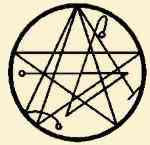
And this is the Sigil of Yhrr, whereof I shall speak further at another time:


With the Ardhamme do then cut thyself in the shape of a cross on thy left arm, let the blood drop on the Sign and speak the words of the Third Formula of Ibn Ghazi:

Uaaah quy-j’gh Ch'nal ci-T'klan nhi Syla
A'nhash Baharri-aka uh'Yog-Sothoth Hu-ehn1

After the blood has been absorbed by the ground place on the same place the grains of Aglaophotis and burn them while speaking the words of the Seventh Formula of Ibn Ghazi:

Y'Toklan, a'nhash Thkhu-aka!
Orr'ep Lym, goka eha-h’rrnhai
Orr'ep Pylan, lash'n-aka-trog!
Orr'ep Lash, n’fhtagni
Nhashantab ekh’shft! 2


Following this, pass thou again the night in meditation and go away at dawn without looking back.
Head back to the clearing on the day following the New Moon and pick up the lump of soil on which thou didst perform the ritual, bring it to thy chambers, put it in a leaden crucible and roast it for three days with cypress wood.
When it cools, thou shalt obtain a bluish-gray powder: speak upon this the words of the Tenth Formula of Ibn Ghazi:

Ha’jynd-math'ungl,
Zara, y'hfl'aeeh
Hastur, y'othaag yh'ehn’hflgh
Orr'ep Zara, y'xhith aeeh3

Reduce to dust a human bone which hath remained uncovered by flesh for at least two centuries, and from this, thou hast the first and the second components of the powder, using three parts of soil from the shunned clearing and three parts of the ground bone; thou dost need only prepare the third component thereof.
To complete it, use one part of Amaranth, one of salt finely ground, and one of very fine leaf of ground leaves of Ivy, completely dry. Compound all together in an open mortar, better be it at the day and hour of Saturn, until everything is uniformly grained, then dampen it with oil in which thou shalt have dissolved a medium-sized pearl.
Keep it, covered with a cloth of wool, within a sealed urn, from dawn to dusk. Open the urn, every night, raise the cloth, make over the urn the Voorish Sign, and breathe upon the mortar the words, 

Hastur ah’ftahas4

then expose it to the night winds, taking it away before the first light appears.
When the oil is fully dry, store the powder in a new, round copper casket —although Ibn Shacabao doth recommend a leaden casket—. After pouring the powder in the box, thou shalt close it, then carve with thy Ardhamme on the lid of the casket, the Tenth Sigil of Koth which Closes, as used by the Scribes of Kutha, who called it the Seal of the Enumah Ehli, which in the ancient Chaldean tongue means “When Opposed”, for the powder creates a contrast between the Shape unseen and its suffusions of purity, enabling the eyes to see the unseen.
This is the Ninth Seal of Koth, or of the Enumah Ehli: 5


Afterwards, wrap the casket in a cloth retrieved from a shroud.

The way of using the powder
This powder shall allow thee to observe the aerial manifestations of the spirits, if thou blow it in the direction of their coming; used after a summoning, it compels That Which was Called to show itself. A small pinch of powder should be blown in the direction of Its appearance from the palm of thy left hand, or otherwise from upon the Enumah Ehli, or with the blade of the Ardhamme.
Mark thee well that thou art prepared for Their apparition with the appropriate words, lest the tendrils of darkness enter thy soul causing slow agony.
Its efficacy does not survive the fourth successive full Moon to the complete drying. When thou blow it from the palm of thy hand, take care that a malicious wind does not throw it in thy eyes, for otherwise thou shalt forever be a slave to Hastur.
When thou desirest that Those Whom thou hast invoked disappear, chant the words of the Thirteenth Formula of Ibn Ghazi:

Imas, weghaymnko,
Quahers xevefaram6

Forget not to make the Elder Sign upon the moment of Its apparition, else the tendrils of darkness may make away with thy soul.
With the Ardhamme thou shalt close the Gate, and thou shalt then seal it with the Closing Sign of Koth.
Thus is the Formula of Ib, which was recovered by Hamurtash Ibn Ghazi himself, from the very Testament of Kish which he did render unto our language.


NOTES:

1. I have attempted a translation of Ibn Ghazi’s quoted Formulae from the sometimes corrupted (and conjecturally restored) R’lyehian; the results are at times quite easy, but in other instances (such as Notes 3 and 5) I offer my conclusions with some reticence. Here follows the Third Formula:
May the Double Crossroads of Blood and Land
Empower this Seal in the Name of Yog-Sothoth.
(This formula had somehow been deleted from my files when I posted the text; here it is, re-translated; I apologize for the misstep)

2. This is the Seventh Formula:
My own spilt Blood, empower this Magick!
Spirit of the Soil, grant thy aid!
Spirit of Fire, these Grains transform!
Spirit of the Grain, awaken!
Increase power together!

3. In the service of the Unspeakable One,
Powder, I consecrate thee.
Hastur, I speak of Thy Holy Names unto the perpetual consecration of fear.
Spirit of the Dust, I bless thee.

4. Hastur, may the Power concentrates perpetually (tentative, but then, words in Thothic languages a grouping coined by Fred L. Pelton which includes R’lyehian, as well as Aklo, Arkandian, Enochian, and Tsath are more conceptual than literal)

5. The identification of the Enumah Ehli as one of the Sigils of Koth has been a personal breakthrough; it is the final missing Sigil of the Thirteen Sigils of Koth which I had been tracking down since Ángel Luis Sucasas set me on their trail with the allusions in his “El Sueño de R’lyeh”, found in Los Nuevos Mitos de Cthulhu (Edge, 2011), and it was not without chagrin that I realized it had been there all along, in Pérez-Vigo’s book, merely not identified as a Sigil of Koth except in the missing text from the other sources! In a near future I expect to present my paper on the Thirteen Sigils and their various sources and purposes.

6. Obstruct! The lapse of time dies unto dawn,
Driven away, back, in acquiescence!


miércoles, 26 de febrero de 2014

The Much-Discussed Couplet

Alhazred's couplet handwritten by Cliff Burton from Metallica


The Mad Arab Abdul Alhazred's pseudobiblium, Al-Azif or Necronomicon, has been translated, mistranslated and falsified many times. I'll collect here various versions of his most famous couplet. I will be updating with other intriguing versions - I have the XIIIth-Century Spanish version somewhere, and I'd like to get the Greek version too. If you know of a good one, let me know!

The couplet is best known in the version used by H.P. lovecraft within his fiction, first published in his short story "The Nameless City" (1921):

"That is not dead which can eternal lie,
And with strange Aeons even Death may die"

This was presumably translated from Olaus Wormius’ Latin version, or perhaps adapted from Dr. John Dee’s Old English. But let us go back in time and consider the possibility, proposed by various authors, that Abdul Alhazred merely translated himself a ritual text from some older source. Robert M. Price has suggested the possibility that it was originally rendered in Greek, either by some earlier author or Alhazred himself, due to the structure and characteristics of the verses; but we will discuss his thesis later on.

Within the pages of the Sussex Manuscript, also known as Cultus Maleficarum, its author, Baron Frederic I of England –which, as is well known by pseudobibliographers, is actually a garbled partial translation of the Necronomicon-, attributes the couplet to the mythical Atlantean poet Klarkash-Ton, chronicler of the Commoriom and Hyperborean Myth-Cycles. This is troublesome in many ways, particularly because it sets the source of the verses in a completely mythical time. Still, it does point the way toward finding a possible source used by Alhazred for his couplet: the Book of Eibon, a Greek book generally acknowledged as one of the main sources of the Necronomicon which purports to contain accounts and rituals from the ancient, pre-glacial country of Hyperborea, and is actually attributed to Eibon of Mhu Thulan, a magician said to have lived in this fabled land.

Consulting the fragmentary Book of Eibon, we find, in Book Four, Chapter 13, “Eibon’s Prophecy,” in which Eibon predicts the fall of the mythical country, which concludes with the following verses:

“…grim and dark Voormithadreth,
King of the high Eiglophian peaks, whence icy rills
Once flowed through caverns black where now the Old Ones lie,
Awaiting that new Day when even death may die”.
(Eibon, translated by Richard L. Tierney)

While Eibon is no less a mythical character then Klarkash-Ton, his book, its actual origins notwithstanding, is an actual document, one known to have been extensively drawn upon by the Mad Poet when writing the Kitab Al-Azif. Therefore, I submit that this may be what Baron Frederick I referred to when he misattributed the couplet to that other chronicler of Hyperborean mythos, Klarkash-Ton. The few surviving epistles and writings attributed to the Atlantean scribe quote Eibon frequently, therefore the Baron might have seen a then-existing fragment which quoted “Eibon’s Prophecy” and noticed the similitude to Alhazred’s quote. The structure of the verses is similar enough: something –the Old Ones in Eibon’s case; undefined in Alhazred’s- awaits the coming time -“that new Day” or the “strange Aeons”-when “even death may die.”

Alhazred’s couplet is noticeably complete in itself, and shows the greatness of his poetry, as he borrows certain elements and the closing phrase from Eibon and creates a short, powerful pair of verses of much wider and deeper meaning. Therefore, he can clearly be considered the true author of the couplet, even if the influence of Eibon is noticeable.

Let us now consider Alhazred’s own version of the verses.

Thanks to the author of the blog Alhazret we have two possible renderings of Alhazred’s original Arabic couplet:

لا ميتاً ما قادراً يتبقى سرمدى
فإذا يجئ الشذاذ الموت قد ينتهي

Or perhaps:

لا ميتاً ما قادر يتبقى سرمدي
فإذا يجئ الشذاذ الموت قد ينتهي

-Abdul Al-Hazred, Kitab Al-Azif (735) would be the source of one of these, the other probably belonging to one of the various unreliable copies circulated after the mad poet’s passing.

William Hamblin’s and Phileas P. Sadowsky’s famous article “Further Notes on the Necronomicon” has popularized an Arabic couplet purporting to be the original:

ما ميتا ما قارد يتبقي
سر مدي فانا يجي الشذاذ الموت
"La mayyitan ma qadirun yatabaqa sarmadhi
fa itha yaji Ash-Shuthath al-mautu qad yantahi"

It’s since become clear that the late professor Sadowsky was far from fluent  in Arabic, and this was probably a recent scribble of no historical importance whatsoever, as I’ve explained in my article Sadowsky's Couplet Re-Translated

Yet another Arabic variant was authored by Abdul Yásar, better known as Abdelésar, a stray disciple of Alhazred who pretended to be Alhazred himself at Al-Andalus, in the Spanish Peninsula, after the death of the poet, and liberally rewrote an incomplete copy of his book. Rafael llopis has authored a book on Abdelésar’s life and philosophy, El Novísimo Algazife, o Libro de las Postrimerías.

Here follows the couplet as found in the Aljavir Manuscript. This was a handwritten copy of Abdelésar’s version of the Kitab Al Azif, found around 1978 by the American pilot Nureddin Ellis at Aljavir, a village about 50 miles northeast from Toledo, which he flaunted before sensationalist occult magazines as “The Nureddin Ellis Necronomicon” and later sold to a collector from Madrid.

The above reads:

"No está muerto quien yace en la Casa de la Eternidad
pues cuando llegue el tiempo hasta la muerte morirá"
-Abdul Yasar/Abdelesar (Traducción de Rafael Llopis), "El novísimo Algazife o Libro de las Postrimerías" (c.740)

The verses vary enough to merit an English rendering:

That is not dead who lies at the House of Eternity
For when the time comes even death shall die

The reference to the House of Eternity makes sense when one considers that Abdelésar claimed to be the son of a pure-blooded Egyptian priestess and having authored Al-Azif as a concealed recreation of the religion of ancient Khem, so he included generous smatterings of Egyptian names and concepts in his handwritten copy. Llopis states that Abdelésar’s mother was a priestess of Ptah-Seker, and my personal studies of the Narratives of the Mad Poet have led me to identify her tentatively with the woman mentioned in the chapters translated by Robert C. Culp for E.O.D.A.P.A, where Alhazred says: “Read of the defilement of the temple of Ptah-Seker, Creator of Heaven and Earth. By corruption of the attendant virgins, I did gain entrance to the inner-most sanctuary”. Alhazred refers at various times to secret sects which preserve certain Egyptian rites –the brotherhood of necromancers, the keepers pf the temple of Ptah-Seker, the archives of Heru-khuti; his very servant and apprentice Martala was a devout of Bast. Nonetheless, let us not go astray considering the the reality and historicity of such survivals; what matters is that Al Burux of Játiva, biographer of Abdelésar, speaks of a surviving secret cult of Ptah-Sokar-Usir his parents raised him into; and when Alhazred refers to just such a cult, it is with contempt, claiming to have “corrupted” the “attendant virgins.” Is it too much to speculate that  Abdelésar could have been brother or child to one such priestess, or perhaps even their offspring?

(I believe this to have occurred before Alhazred’s well-known mutilation and castration, as described by Ibn Khallikan and Theodorus Philetas. While Donald Tyson’s excellent biographical novel Alhazred does not allow for this to have occurred, it must be kept n mind that he greatly condensed the most important periods in the poet’s life for the sake of narrative efficacy).

The following may be a rendering of the couplet, or then again, it may be derivative text altogether:

“Thou shalt conjure the dead, using the names of their evil gods. They shall come forth, for they are not dead, but lie eternal, unto the time when death is vanquished. And they will come forth when thou callest them by their gods.”
-Al Rashid of Sothis, The Book of Shades (ca. Xth Century), translated by Mrs. Ruzo.

This book was published by Elizabeth Ann St. George as possibly a part of the Necronomicon. While it may well be so –St. George never explained at length her reasons to believe so- this is a prose translation from an Arabic text which, while similar enough to be clearly influenced by Alhazred’s couplet, may or may not be a rendition from the original Arabic verses. Certainly, those transcribed above are both similar enough both between each other and to Al Rashid’s.

We are indebted to Deinolithos for discovering the Greek version of the couplet:

οκ λαχον θανάτοιο μέρος κατακείμενοι αεί·
καινοτέρων τέων κα θάνατος θάνεται.
(ouk elakhon thanatoio meros katakeimenoi aiei
kainoterōn eteōn kai thanatos thanetai.)
.Theodorus Philetas (ca. 950)

Deinolithos translates the verses as follows:

They have no share of death who always lie:
In stranger years to come, e'en death shall die.

Also, Denolithos makes the following comments:

“The verb thanetai, "will die," is quite unusual. This form occurs only once in all of Greek literature, in one of the Sibylline oracles where it's part of a prophecy. So the wording of the Greek couplet suggests it's making a prediction: death will die during the ‘stranger years.’

“Theodorus's choice of meter reflects the revival of interest in the elegiac couplet during the reign of Constantine Porphyrogenitus. That he didn't quite attain to Classical standards of versification is understandable: he produced his translation under severe constraint, with continuous threat of persecution if he were discovered, and of madness if he were too successful in unlocking the book's secrets.”

What surprises me is the absence of the word αιώνες (aió̱nes) –the “strange Aeons” in both Lovecraft’s, Dr. John Dee’s and Baron Frederick I’s versions. Was then the term’s inclusion entirely the work of Dee? I had previously found a Latin version which included a latinization of the term, but it has since surfaced that it may have been a false rendering (see below).

The concept of Aeons, which has recently come to signify exclusively periods of time, had in the Middle Ages much more complex connotations, as Robert M. Price rightly observes in his monograph “A Critical Commentary on the Necronomicon”, perhaps derived from Jewish apocalypticism:

“there were to be two successive world ages (aions), the present one ruled by Satan, with the future Golden Age to be ruled by God. Eventually, the word aion may have come to be used derivatively to indicate not only the world age, but also the power who ruled it. The Gnostics may have picked up the term in this way. Alternatively, the term may have come from the lion-headed Iranian god of Time, called Aion.”

 Price goes on to describe the similarities between Alhazredic Daemonology and Gnosticism, concluding:

“In light of these parallels, it is hard to resist the conclusion that the religion of Alhazred was one of the lesser known branches of the Gnostic religion. The Old Ones were known in that context as Aions.”

Later on, when performing a directly analysis of the conceptual parallels within the structure of the couplet, Price suggests that it was “originally composed, not in Alhazred’s Arabic, but in Greek, where the words ‘eternal’ and ‘aeon’ are simply different forms of the word aion, or ‘age.’ English ‘eternal’ would then translate into the Greek phrase eis tous aionus, literally ‘unto the ages’, ‘always’ or ‘forever.’ This would, in classical fashion, allow a double meaning or pun, using Aion as both a period of time and a divine entity:

“According to this interpretation, to ‘lie eternal’ (meinai eis tous aionus) means not ‘to abide forever’ (as does Cthulhu in R’lyeh), but rather ‘to await the Aions’, i.e., the Old Ones.”

Of course, Price works speculatively here, without having access to Philetas’ text; still, his points are valid, and a great richness in significance is lost if we discard the word Aion or Aeon as a late English interpolation. The question may be set forth, though: could more than one version of the couplet be found within a single version of the book, be it Arabic, Greek or Latin? After all, not only the couplet is reiterated at various times throughout the Necronomicon corpus, deliberate variant versions might exist, displaying similar concepts through careful nuances that shift their meaning, and have been misconstrued by later translators as clumsy attempts to repeat the same verses. I invite readers to keep in mind this possibility as we continue to explore these variants.

There was a second, previously unknown,  Greek translation (not by Psellus, this is a common misconception popularized by the pseudonymously-named Justin Geoffry in recent years, although Psellus seems to have owned a copy); it was translated by Teofilatto o Pissarios, a Byzantine mystic who endeavored to re-translate the book from the original Arabic  for his Euchite cult after finding Philetas’ version incomplete and unreliable in various ways.

We have only Pietro Pizzari’s Italian translation of Teofilatto’s Greek, from the manuscript found in the Vatican Library:

"Non è morto ciò che in eterno può attendere.
Con il passare di strane ere anche la morte può morire"
-Teofilato o Pissarios (1070)
(That is not dead which in eternity may wait.
With the passing of strange eras even death may die)

Intriguingly enough, we find no mention of “aeons” in this version either; unfortunately, Pizzari does not reproduce the original Greek version.

This is a good moment to discuss the version of the couplet found in Necronomicon: Nuova edizione con sconvolgenti revelazioni e le Tavolette di Kutu (Dr. V. Carranza & Prof. Z. Shah, Fanucci, 1994). The version, rendered by the translator Sergio Basile, is all too close to Pizzari’s:

"Non è morto Ciò che in eterno può attendere.
E con il passare di strane ere anche la morte muore"
(That is not dead which in eternity may wait.
With the passing of strange eras even death dies)

While Carranza and Basile seem to have worked from a scanned copy of what appeared to be the original Kitab Al-Azif, composed of an Arab manuscript and various Greek sections of earlier origin, their rendering of the couplet is too modern, and probably attempts to be as close as possible to the Italian translation of Lovecraft’s version (it bears wondering whether that is also the case for Pizzari).

We also have two Latin versions of the couplet. Deinolithus offers a rendering found in a XVIIth-Century edition of Celsus Olaus Wormius the Elder’s translation of the Necronomicon:

“Illud non moritur quod polleat usque morari:
temporibus miris, Mors, potes ipsa mori”
-Olaus Wormius the Elder, "Necronomicon, vel De Normis Necium" (1228)

A literal translation would be:

That does not die which may linger for aye:
In strange times, Death, e'en you can pass away.

Deinolithus also has the following observations about this version:

“Notice that the Latin version addresses a personified Death in the second line. There's a play on the sound of the word for ‘death,’ mors: that which escapes death has the power to ‘linger,’ morari, continuously; in times that are ‘strange,’ miris, Death itself can die.

“The two words that end the first line, usque morari (‘linger continuously’), are a reminiscence of Vergil's Aeneid, book 6, line 487, where Aeneas wishes to linger in the underworld to speak with the ghosts of his dead countrymen (…) The Latin translator of the Necronomicon must have perceived a connection between the mad Arab's couplet, and Vergil's description of the realm of the dead.”

However, Dr. Arias, from Universidad Valencia de Montecruz, had previously given me the following transcription, found in Stéphane Gesbert’s monograph “Cthulhu Dark Ages” (Miskatonic Paramythology Journal Nº 7, Summer 2010):

"Mortuus non credite illud quin latet aeterno,
Quum per Saecula mira Mors etiam pereat"
-Celsus Olaus Wormius the Elder, (1228)

In my earlier compilation, which I posted on my Livejournal years ago, I transcribed a nearly identical couplet which read “per Aeones mira” instead of “per Saecula mira”; the dubious inflection makes me suspect that the document I copied it from –an old letter at the Universidad Valencia de Montecruz collections- was adulterated; however, the question does  come up again: at which point was the concept of “Aeons” brought into the couplet? Bewfore the mad poet’s times as suggested by Price, perhaps as a verse found in the collection of magickal papyri stolen from the library of Alexandria which, according to Dr. Andrés Venustiano Carranza, became the core of Alhazred’s opus? By Philetas’ or Teofilatto’s hand, in one of their Greek recensions?  As a barbarism on Olaus Wormius’ behalf?

Or did Dr. Dee draw from his extensive studies of the Gnostic writings?

"That 'tis not dead the which mayest for-everr lye,
& with ye advent of strange Aeons, even Death mayest die"
-Dr. John Dee, Necronomicon (1586)

Dee worked for many years in his obsessive translation of the Necronomicon, something which defies reason due to the decidedly un-Christian character of the book; he worked from a Latin copy, at least two fragmentary Greek texts, and possibly a few portions of an Arabic manuscript. Here, the polemical term is clearly present, and we approach the most familiar of all translations, the modern English version which became a staple of twentieth century weird fiction:

"That is not dead which can eternal lie,
And with strange Aeons even Death may die"
-H.P. Lovecraft, "The Nameless City" (1921)

It has surfaced that Lovecraft had access to both the corrupt Dee translation kept by the Freemasonic Egyptian Rite Boston Lodge and the Latin copy at Miskatonic University, and it is strongly rumored that his grandfather Whipple Phillips kept yet another Latin copy in his library. Stories of Lovecraft finding the Necronomicon at an Umyadi monastery in New York City are just as hard to prove or disprove.

The finest Spanish translation is owed to Lovecraftian scholar and definitive translator Francisco Torres Oliver, and there are two versions with one minor variation (the second lacks rhyme but is preferred by many, me included):

"Que no está muerto lo que puede yacer eternamente,
Y con los evos extraños puede morir aun la muerte"
or,
"Que no está muerto lo que puede yacer eternamente,
Y con los evos extraños aun la muerte puede morir"
-Francisco Torres Oliver, Relatos de los mitos de Cthulhu, Bruguera, c.1960)

But it is not the first time these verses have been rendered unto Spanish. It is known that the Necronomicon has been translated to this language several times:

The crusader José Luis de Ancona translated at León, Simancas, between 1274 and 1300 –as found out by researcher Inti Meza V.- an Arabic copy he found in Abisinia under the title Libro de lo que dizen los espíritus del desyerto (Book of What the Spirits of the Desert Speak); only one handwritten copy of this never printed version survives at the Simancas Historical Archive. Francisco Torres Oliver and Rafael Llopis were preparing an annotated edition slated for 1981, but it was cancelled due to the polemics when reputed author Joan Perucho was accused of plagiarizing parts of his book Botánica oculta o el falso Paracelso (Taver, Varcelona, 1969) from the Necronomicon.

Necronómicon ó el Libro de los Árabes (Necronomicon or the Book of the Arabs), printed by Miguel Plata (Toledo, 1647) is the translation mentioned in Lovecraft’s “History and Chronology of the Necronomicon;” it was produced by the philosopher Hugo Sempilio (Hugh Semple) from a Latin copy.

According to Joan C. Stanley in her Ex Libris Miskatonici, none other than Miguel de Cervantes authored another translation, also from the Arabic, titled Libro de los Nombres de los Perdidos (Book of the Names of the Lost) during his imprisonment in Algeria (1576-1579). For reasons I’ve been unable to ascertain, there appear to be existing copies of this version mistitled Libro de los Normos de los Perdidos, “Normos” being a nonexistent word in ancient or modern Spanish. I propose that at some point, copies of the book were printed or at least bound by a printer unfamiliar with Spanish.

Only recently a reference to yet another Spanish edition has come to my attention: Necronomicon, el libro de los nombres de los muertos (Necronomicon, the Book of the Names of the Dead), translated by a priest Pedro de Perreras and printed at León, ca. 1498.  Notice that León is the same place where the 1274-1300 translation was done, so it might well be an instance of misattribution. Still, I have as yet been unable to confirm the existence of this previously unknown edition.

I have yet to obtain any of these copies; if anybody has access to one of them, and would be so kind as to transcribe their version of the couplet, it goes without saying that many of us will no doubt be enormously thankful.

Here is, however, the version quoted by Martín Diaz in the extensive treatise he wrote, trying to correlate the contents of the Necronomicon to Mesoamerican indigenous traditions and geography, as transcribed by Mauricio-José Schwarz for the science journal Umbrales:

"Lo que muerto no está puede yacer eternamente.
Con las extrañas eras la muerte acaso muere"
-Martín Diaz, "Vera historia de los bolcanes de la Nueva España" (1710)
(What dead is not may eternal lie,
Wth the strange eras death mayhap dies)


A Russian translation has come up, part of a collection of translated fragments of the Necronomicon, of unknown authorship. Patricia Mason suggests these may be part of the personal notes of Rasputin which he is said to have lost, along with his Latin copy of the book, in 1908 when he disappeared for several weeks near the Podkamennaya Tunguska river in Siberia, when his belongings were stolen frm his lodgings in the meantime. Whatever the truth, here is the couplet:

то не мертво, что вечность охраняет,
смерть вместе с вечностью порою умирает.
to ne mertvo, chto vechnost' okhranyayet,
smert' vmeste s vechnost'yu poroyu umirayet.

As with the Arabic versions, I confess my knowledge of the language is too scarce to be able to make any further comment.

Lastly, we  have a couple of much stranger renditions.

“Mgw’ngh naflwgah shugg fhtagn,
Y’ai’ng’ngah y’haa g’kthun cfay’, wgah n’gh nagl”

This would be a R’lyehian language translation of the couplet, found in February 1998 by John L. Smith jotted down on the margins of the Miskatonic University’s copy of the Necronomicon. Whether the anonymous scribbler copied it from an earlier source or simply attempted a translation “on the spot” is impossible to tell.

The aforementioned Teofilato’s I Sette Libri dei Nomi dei Morti, detti anche il Necronomicon (The Seven Books of the Names of the Dead, also called the Necronomicon) offers us a very different version:

"Yi yibuly hy'm bji nwyb im hjcuj otlmuji rack'jo yijrr
A'yoyb kbm'ea uriy rukniu ijrj'ob yesov bll'ruc'oxii ljvij"

-Abd al-Azraq (Abdul Alhazred), in the "sacred language of R'lyeh" según Teofilato (1070)

 This language is very different from R'lyehian as found in Lovecraft or in Philip Marsh's essay R'lyehian as a toy language, yet they do share a few words while structure seems very different –actually, Teofilatto’s language appears to lack any structure whatsoever, and the chants, although accompanied by supposed translations, hardly ever reproduce the same words beyond a few consecutive verses at most, as if the language itself shifted in continuous transition as the text progresses. This is perhaps a hieratic or symbolic language and the other one, the Deep Ones' common tongue; if so, rather than a literal translation, the non-human language is meant as a cipher of some kind, containing further secrets that expend from the ordinary verses.

Lastly, I again request the aid of fellow researchers; if you know of other available variants of the couplet that deserve discussion, do not hesitate to contact me either here or through my Facebook page.

Bibliography:

ABBADIE, Luis G: El Necronómicon: un comentario. La otra orilla, 2000
ALHAZRET, comments on “Sadowsky’s Couplet Re-Translated” (q.v.) See his blog Alhazred in Cultural Context
CARRANZA, V., & SHAH, Z.: Necronomicon: Nuova edizione con sconvolgenti revelazioni e le Tavolette di Kutu. Fanucci, 1994
CULP, Robert C.: “Necronomicon”, in Robert M. Price (ed.)’s The Necronomicon: Selected Stories and Essays Concerning the Blasphemous Tome of the Mad Arab (Chaosium, 2002)
GESBERT, Stéphane: Cthulhu DarkAges. Chaosium, 2004
HAMBLIN, William: “Further Notes on the Necronomicon”, in Call ofCthulhu, Chaosium, 1994
LLOPIS, Rafael: El Novísimo Algazife, o Libro de las Postrimerías. Hiperión, 1980
PELTON, Fred L.: A Guide to the Cthulhu Cult. Armitage, 1998
PRICE, Robert M.: “A Critical Commentary on the Necronomicon”, in Robert M. Price (ed.)’s The Necronomicon:Selected Stories and Essays Concerning the Blasphemous Tome of the Mad Arab (Chaosium, 2002)
SCHWARZ, Mauricio-José: “En la hora del volkán”, in Umbrales Nº 14, Feb. 1996
SMITH, John L. Lovecraftian Qabalah (website dead)
STANLEY, Joan C.: Ex Libris Miskatonici. Necronomicon Press, 1995
ST. GEORGE, E.A. (ed.): The Necronomicon, or the Book of Shades. Corvus, 2006
TIERNEY, Richard L.: “Hyperborea; or, Eibon’s Prophecy” in Robert M. Price (ed.) The Book of Eibon (Chaosium, 2006)
TYSON, Donald: Alhazred. Llewellyn, 2006
     -Necronomicon: The Wanderings ofAlhazred. Llewellyn, 2005

Also, thanks to Ryan Parker, the staff at Miskatonic University in Arkham, Mass. (USA), Universidad Valencia de Montecruz, Jalisco (México) and priest Atal from Ulthar at the temple of Elders.

“The Much-Discussed Couplet” Copyright © 2014 Luis G. Abbadie