Mostrando entradas con la etiqueta necronomicon. Mostrar todas las entradas

martes, 4 de mayo de 2021

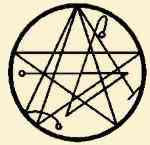
The Brazier of Eibon and the Rite of the Black Flame

(A chapter from Abdul Alhazred’s Necronomicon,; translated by Luis G. Abbadie)

Thou shalt procure a brazier fashioned from black stone or clay, with three legs, sufficiently large to receive the offerings when it is convenient. On the day of the Sun, and in the hour of Venus, thou shalt inscribe on its side the Seal of Eibon, on one side, and the Elder Sign on the other. For the Seal of Eibon with its three arms will concentrate and disperse, for the benefit of your Operations, while N’tse-Ka’ambl, the Granter of the Elder Sign, is She who presideth over the Black Flame which thou shalt summon and manifest. This is the flame that forms the heart of the Pillar of Fire served by the long-bearded Priests Nasht and Kaman-Thah. This is also the Fire that burns in the heart of each Star, and projects the colours and shades which fill the sky with poison for the Great Old Ones, as well as those which strengthen and release Them.

This is what the great Magician and Necromancer Eibon, from the forgotten hyperborean realm of Mhu Thulan, testifies, and narrates in his Scriptures, of how on one occasion Eibon travelled through the southern provinces of Hyperborea, in the course of his searches for arcane knowledge; and in doing so, he decided to pay a visit to the Necromancer Vinnijar, of Camorba, from whom he hoped to obtain certain rare herbs peculiar to the region of Uthnor, which would prove useful for his sorcerous crafts. Vinnijar abode in a residence secluded from the city, between two crags on the other side of the forest of Ramooz, and Eibon, having arrived in Camorba shortly before dusk, set out thereto upon dawn the following day. Upon his arrival, he found some logs and a bucket abandoned before the front door, and surmised that he would have the opportunity to see his colleague reprimand the laziness of his servants. He had not seen Vinnijar for more than two decades, but well did he recall his great propensity to outbursts of anger, and his shortness of patience. Presently, Eibon knocked on the door, and found no one coming to greet him. He knocked harder, and the door swung open loosely. Surprised, Eibon entered the room, and found two other logs lying on the floor, in front of the fireplace in which the fire was reduced to nearly-extinguished embers. As though the servant who fed the fire, he reflected, had fled in so untimely a manner that he had at first forgotten to drop the wood he had just brought with him.

“Vinnijar!”, The sorcerer risked calling, but as he suspected already, he obtained no answer. Therefore, he ventured inside the dwelling, heading for the stairs. He suspected that the best place to find Vinnijar would be his laboratory, and it would probably be located on the upper floors, but otherwise, it might also be found in the basement.

Eibon went upstairs then, careful to make no noise, as he anticipated that he might encounter something extremely unpleasant, and possibly dangerous. And indeed, it took not long for him to see traces of blood and what could only be guts, scattered on some of the steps before reaching the next floor.

To his left, an open door revealed what he was looking for: the materials and implements of an alchemist cluttered a table, with a shelf full of scrolls beyond it. He approached cautiously, and as he looked in, he saw the edges of a Circle of the Artes laid out on the flagstones of the floor. When the sight became clearer, as he advanced, he noticed that in the perimeter of the Circle there were a dead censer, an open parchment, and more peculiarly, the remains of some already-eaten fruits. As he passed through the lab door, his gaze met that of wild-eyed Vinnijar.

The Necromancer sat, crouched, in the center of the Circle, his robe dishevelled, his hair tousled; and his fear and surprise-fraught eyes were framed by a haggard and pale face. Despite being in the Circle of the Artes, Vinnijar did not look as if he had been interrupted in the middle of some experiment at conjuring.

“Vinnijar!” Eibon saith upon seeing him, and looked around apprehensively. “What has happened here?”

The Necromancer looked around in panic and gestured to silence him.

“Speak not aloud, O Eibon!” he warned. “You could be heard!” Then, approaching the edge of the Circle, he muttered urgently, as if certain that time was short. “It awakens hope in my heart to see thee, my friend,” he saith; “May Tsathoggua let thy arrival announce my salvation, and not thy companionship in doom! Know thee that last night, I was preparing to conjure the Spirits of the Abyss and, after imparting the usual directions to my servants, I set out to carry out the Operation. Too late, I realized that young Rahli, the cook's teen-aged son, who despite my instructions tends to get distracted while I talk to his elders, must have picked up my Brazier from the ground, perhaps believing that it was not part of my instruments since my censer was also at its side. There has he put it, out of my reach!” He pointed to a shelf where, indeed, a Brazier with the Elder Sign inscribed was to be found. “All the rest was due to my own recklessness,” the Necromancer lamented; "when I found it not in my Circle, the need to use it escaped my mind, and the room has been left lacking the complete purification and warding required for the manifestation, without risk, of the Outer Forces!” Vinnijar shook his head in desolation. “That which I called, came in response; unrestrained, it attempted in vain to invade the perimeter of the Circle, and failing to do so, it left to prowl the house. I have heard the screams of horror from the servants, until silence fell. Then it came again, and it has spent the whole night tormenting me, mocking me, with the certainty that sooner or later, fatigue will prevent me from reinforcing the protective barriers, and it will be able to reach me.”

“In that case, ‘twill surely be well within my hands to succor thee,” Said Eibon in order to appease his anguish, otherwise he would not be able to answer certain questions that were of the essence. “But tell me, oh Vinnijar, what is That which thou hast invoked, and which now prowls in this house?”

At that moment they both heard footsteps of a peculiar rhythm coming down the corridor. Eibon glanced over his shoulder, but nothing showed still through the open door.

“Vinnijar! Quickly! What is it?”

“A Shadow from Arkand,” he said, causing Eibon to shudder, as the horror on his colleague's face told him that It had already come.

But what was found at the door was not a Demon of bestial form, nor a living shadow, but a woman, elderly and robust, her clothes soiled with blood. But her face, her eyes! They betrayed an aberrant Presence within what was clearly a corpse, since her open throat showed the marks of a large, bestial claw. Her eyes blazed with a demonic yellow gaze, and a grinning grimace distorted what must once have been a gentle face brimming with the shallow wisdom of the elderly country dwellers. And in her left hand she carried a long, thick stick, plucked from some shed.

“’Tis time to devour thy soul, Sorcerer,” said she, and then, looking at Eibon, she added: “How kind of thee to bring new food for my brethren!”

Eibon, who well knew, from the Pnakotic scriptures, what the Shadows of Arkand were, which are in the habit of seizing corpses and turning them into abominable Necrites or Deadites, those selfsame horrors which had ravaged Arkand at the latter days of a previous Cycle, replied nothing; he merely stepped back, without averting his gaze from that aberration, to stand behind the table cluttered with retorts and urns. The grinning Deadite watched him, finally turning her attention to the Necromancer who crouched within the Circle.

“But ‘tis time, first, to pay thy debt,” said the thing, and raised the stick as if it were a spear, ready to impale Vinnijar.

Eibon moved with swiftness and discretion, reaching across the table to take the Brazier. If it was empty, he would have no time to prepare it, and they would both be lost. But he found it filled with coal. Silently thanking Tsathoggua, he was about to use his tinderbox to ignite it, but he stopped. His gaze fell upon an urn marked with the symbol used by Hyperborean Alchemists to designate oil, and under it, the Seal of Ubbo-Sathla. Eibon grasped it, and poured it until it the coals were half-covered in it. The fire then ignited with great ease, crackling in an unexpectedly thunderous way. 

The Seal of Ubbo-Sathla

The Deadite looked at him in bewilderment. But the stick was no longer in her hand. Eibon caught a glimpse of his friend, the Necromancer Vinnijar, with the stick nailed into his abdomen and writhing in pain as he backed away from the Circle and leaned his back to the wall. But then the thick, warm scent of burned Oil invaded his lungs, choking him, causing his eyes to fill with tears. The Deadite let out a scream more like that of a vulture or winged dragon in agony than like a human cry. Eibon, unable to see her with clarity, turned away and approached Vinnijar, who was collapsing to the ground. Eibon put his hand on the shoulder of the dying Sorcerer as his still-stinging eyes searched for the Deadite: she crouched with her back to the brazier, covering her face as if the fumes were those of a mountain’s liquid fire, unceasingly screaming.

“Eibon…” the Necromancer managed to articulate, and life left his eyes. Eibon stood up and hurried across the room. As he passed the wriggling Deadite, she reacted and rose after him. But Eibon was quick enough to shut the door in the face of the abomination.

“Get thy share,” Eibon said in response to the shrieks and curses that accompanied the banging on the door. The Flame of N’tse-Ka’ambl was purifying the interior of the laboratory, turning it into a space whereat a Being of darkness like the One which animated the Deadite was not capable of surviving. Still, Eibon held his breath, fearing the thing might have enough presence of mind to recall the window and jump out; However, it did not. The banging slowed, the screams reduced to gasps, and finally there was silence.

Eibon then allowed himself to sigh in relief, and left. Let the peasants eventually discover the tragic scene, and let the pious Priests of Yhoundeh exorcise the site, claiming the fate of the Necromancer as a morality fable against the Sorcerous Arts and a triumph for their Goddess. ´Twas another, greater and elder, Goddess who had vanquished the horror this day; and another more mundane and bitter moral which was presented here: When carrying out thy Rites, never forget the unattended Fire, whether it be burning... or unignited.

Bear then in mind the experience of Eibon, that thou dost never forget the importance of the Black Flame upon thy Altar.

The Flame must be lit on coals sprinkled with Ubbo-Sathla’s Oil, which is prepared in the following way: Boil leaves of ivy, cypress and walnut in a base of tree oil, and unto the resulting mixture, once cold, add powdered sulfur and camphor. And when preparing it, make the Sign of Voor over it and say:


Ubbo-Sathla h’ftahas


In this manner, the source and substance of earthly life nourishes and feeds the Flame which in turn burns in its entrails and awakens the substance to life.

On the first occasion of its use, the Brazier must be duly consecrated with the Greater Consecration, and then the interior of the brazier anointed in Ubbo-Sathla’s Oil, which will no longer be necessary on subsequent occasions; then place coals inside, sprinkle them with oil, and kindle the Fire; while it burns, make the Elder Sign while spealing the words:


Granter of the Elder Sign

N’tse-Ka’ambl

Mistress of the Flame

N’tse-Ka’ambl

Shatterer of Worlds

N’tse-Ka’ambl

Queen of the Heavens and the Abyss

N’tse-Ka’ambl

Kindle here Thy Flame.


¡C’vo Ch’Isesa Xizo-Ati-Ni-Tho!


Thou who doth grant us protection

Grant me now Thy Black Flame

Thou whose shield nothing may pierce

Shield me in Thy heat

Thou who guardeth the Ancient Knowledge

Kindle in me the Flame of Wisdom

Thou who hath conquered Ganzir

Light my Path in light and in shadow,

Kindle here Thy Flame.


¡C’vo Ch’Isesa Xizo-Ati-Ni-Tho!


Uvhss-J’hon,

Radiant Blackness from Sharhah's entrails

Uvhss-J’hon,

Wall of Fire before the horrors of Yuggoth

Uvhss-J’hon,

Lighthouse of Justice in the Palaces of Glyu-Vho

Uvhss-J’hon,

Eternal Fire from the Sanctuary of N’tse-Ka’ambl

Kindle here Thy Flame.


¡C’vo Ch’Isesa Xizo-Ati-Ni-Tho!


In the Name of She Who conquered Ganzir,

By eris will and Her Word,

Uvhss-J’hon,

Black Flame rare and resplendent,

light up now this Circle of the Artes

May every Shadow boweth to Thy light.

Uvhss-J’hon,

Black Flame of Wonder,

Bless me with Thy protection.

N’tse-Ka’ambl,

Bless me in my Workings,

Kindle here Thy Flame!


¡C’vo Ch’Isesa Xizo-Ati-Ni-Tho!


In thy Rites, thou canst also feed the Fire with branches of willow.

 Thou canst also consecrate a bonfire to light the Black Fire upon it, although this is not common except when in Rites with numerous participants, as was done in the times of the early Chaldean; on the contrary, you can also summon the Black Flame by lighting a black candle. However, keep in mind that, when thou dost want to deliver an offering unto the flames, this is not possible with the candle’s small flame.

 Another way, the most powerful, to propitiate Those From Outside, is the Red Offering, which I shall presently speak of.


The previous narrative is a previously undisclosed chapter from Alhazred's opus, rendered from an incomplete Greek text and a severely damaged corresponding section in Wormius' latin version. We have recently had an unique opportunity to cross-check the narrative with the corresponding chapter of the Book of Eibon, thanks to the near-complete copy of Gaspar DuNord's XIIIth Century Livre d'Eibon found as part of the Brzobohatý Files curriently under research at Universidad Valencia of Montecruz, Mexico. 

It bears mentioning that I have favored professor Raymond Knowby's barbarism "Deadite" over the correct Greek term "Nekrite" mainly due to the former being a more familiar word for most readers. 

"The Rite of the Black Flame" has been rendered in careful accordance and cross-check with the works of Joseph S. Pulver, Sr., who was the original translator and researcher who undisclosed the mysteries of the Black Flame or Uvhss-J'hon, after his discovery of the Eibonic scripture "The Adoration of the Black Flame" (to be found in Chaosium's The Book of Eibon).

A long way back, I remember reading an article titled "Wicca 101" at the much-lamented website The Witches' Voice. In it, the author described a neophyte's hypothetical first ritual attempt, narrating how, after tracing the circle, the student might sit before their altar, relax, breathe deep... listen to the sounds of the night... and recall the coffee pot they left on the flame at the stove! Eibon, through Alhazred, suggests that this has been an age-old problem for witches and necromancers! 

martes, 27 de diciembre de 2016

The Powder of Ibn Ghazi – The Full, Never Before Revealed Formula

A full Chapter of Abdul Alhazred’s Necronomicon, reconstructed from existing fragments

(Now complete with the missing formulae)

This is generally thought of as a well-known chapter of Alhazred’s ill-famed Book. However, knowledgeable readers will scarcely be surprised when I mention that, upon consulting various versions and texts of the Necronomicon, some of its contents prove to be bafflingly divergent, even contradictory at times. This is not particular of the work in question; a similar comparison of the various existing versions of Solomon’s Clavicles will offer similar results.
I have chosen the following text as particularly representative of the problem faced by researchers of Alhazredic Daemonology. This is one particularly famous formula, and it is found in many, if not most, versions of the Book, but the fact remains that the best-known version is that found in Dr. John Dee’s Liber Logaeth. Now, the text published by Hay, Wilson, Turner et al. is certainly a classic of its type, but it must be kept in mind that Liber Logaeth represents but the beginning of Dr. Dee’s lifelong obsession with the Necronomicon. Across the years, the Elizabethan magician and scholar gathered several fragmentary copies of the Necronomicon in various languages, and worked feverishly on them.
Dr. Dee obtained a copy, possibly of the 1472 edition, and set down a series of notes which included a shortened translation of several chapters; for unknown reasons, Dee codified these notes in 1583, as the cipher manuscript Liber Logaeth. Dee would produce a fuller translation in 1586, working mainly on a copy of the Arabic Kitab al-Azif which he had found in Prague three years earlier, and including material from the Greek and Latin texts (he had access to the Greek copy in the library of Carpathian Baron Hauptmann), as well as from some Alhazredic material reproduced by Alkindi in his great compilation of magical treatises Kitab ma'ani al-nafs or Book of the Essence of the Soul (c. 850). Lin Carter (1930-1988) obtained in the 1950's Dr. Dee’s original 1586 manuscript, and began a laborious annotated transcription of which he published a few fragments —from 1971 onwards—, but his work was truncated when a great number of his notes for the rituals’ section was stolen and his work was left incomplete.
His literary executor, Robert M. Price, published the entire transcription as left by carter in 1990, in the respected academic journal Crypt of Cthulhu, and has since continued the labor of transcription of a few further chapters of the manuscript.
In 1589, Dee had privately printed a copy of his 1586 manuscript with further notes and revisions; no more than two copies were apparently produced.
Upon his death in 1608, Dee had an even more complete manuscript version of the Necronomicon, but it was never printed and is now considered lost.
Going back to Liber Logaeth, which Robert Turner deciphered and published in two volumes, beginning in 1978, I cannot stress enough that its translations from Alhazred are obviously shortened and incomplete; while it is common for transcribers and translators of old times to liberally abuse the source texts, omitting and adding as they saw fit, Dee did not attempt a full translation of the passages included but more of a lengthy synopsis; besides, being a devout Christian (which is the reason that his continuing interest in the Necronomicon baffles his biographers), he no doubt omitted and censored several aspects which he found particularly disturbing (something, it must be acknowledged for his benefit, he clearly attempted to do far less in his subsequent works).
Therefore, the widely accepted version of the famous formula for the powder of Ibn Ghazi, noted because of the work done by Dr. Francis Morgan from Miskatonic University in the early decades of the XXth Century, is not the full formula he found in Wormius’ full, Latin version, but a sorely fragmentary fragment of it!
What follows is a careful reconstruction, drawing from the Arabic copy partially translated by Professor Venustiano Carranza, Sergio Basile and Giampero de Vero for Necronomicon, il Libro Segreto di H.P. Lovecraft (Fanucci Editore, 1994), the Spanish copy or “Algazife” published by Fernando Pérez-Vigo as El Necronomicón y Tarot Necronómico (Casa de Horus, 1992), the Italian manuscript found in the Vatican Library by Pietro Pizzari in Necronomicon, Magia Nera in un Manoscritto della Biblioteca Vaticana (Atanor, 1993) and the Polish manuscript Necronomicon Czyli Księga Zmarłego Prawa edited by Krzysztofa Azarewicza (FOX, 2000), as well as the copy of Olaus Wormius’ 1228 Latin version kept at “Antonio Hernán” Library in the Universidad Valencia de Montecruz special collections.
Among the many questions this text is certain to raise, far from the least is, why is this identified as “the Formula of Ib”? Is this an odd corruption derived from the casual similarity of Ibn Ghazi´s initial letters with the name of the legendary city, described elsewhere in the Necronomicon, which caused the Doom of the inhabitants of Sarnath? Or was the powder originally used in Ib, perhaps by its inhuman dwellers or by their human neighbours, as it is perhaps explained in some yet-missing passage? Maybe further exploration of the Book will render an answer.
A final caveat remains: read with care, and use with every possible caution.

Yog-Sothoth Neblod Zin,

Luis G. Abbadie
Dec. 27, 2016
al-azrad.blogspot.com


To Make the Powder of Ibn Ghazi, or the Powder of Materialization, which is the Formula of Ib


I am the Scribe of the Old Ones, Those who were, are and shall be indifferent; blessed be Their secret Names.
This is how thou shalt obtain the powder with which the great Ibn Ghazi —may none doth meet an end like the end which claimed him! —, could make visible the Other Gods and the infamous beings by Them spawned among humanity.

The way to prepare the powder
Atop an isolated hill in the countryside thou mayest happen to find a clearing where there remaineth but the bare ground and it seems that nothing alive might be able to sustain itself therein. Note well: it shall not be merely a place with dry grass but an actual clearing with no trace of grass, with soil, dust, rocks and nothing else, ‘twill be a place which birds and foxes and even insects doth seem to avoid, a strangely silent place that would seem like the throne of death.
Take note of the place and return there on the first night of the New Moon. If thy wicked Spirit doth assist thee, thou wilt find that upon the center of the clearing stands, barely perceptible in the darkness, something that doth resemble a vapour —strange in such a barren place— visible even in the dark because it will give off a slight greenish glow.
Thou shalt then know that thou hast had the ill luck to have found one of the places where the remains of the monstrous beings spawned by the Other Gods among men are buried. Thou dost already know that their being “buried” does not necessarily mean, certainly and definitely with no more life; however, even if thou were to feel panic, run not away or ‘twould be worse for thee. Sit instead in the clearing at ten paces from the vapour, facing in the direction of the setting Sun in order to watch the vapour. Gaze upon it, observe the shapes it doth assume and discard endlessly, meditate and tremble not. Close not thine eyes, no matter how horrendous may seem to thee those forms or the memories they will arouse. Close not thine eyes even if the rising wisps of steam doth always appear on the verge of coalescing unto Something whose mere vision may be able to snatch away thy reason and leech thy brain. Close not thine eyes, run not away or ‘twill be thy end. Meditate until the Sun doth not yet rise behind thee. Then rise, and go home and no matter the reason never look back. In this way dost thou establish the proper link between thee and the One that, in some manner, not dead and not alive, doth inhabit the clearing: in this way dost thou establish thy right to use Its powers.
Three days before the next New Moon, return to the clearing after the Sun has set bringing with thee the black candle and the Ardhamme of the Great Goddess. Set thyself in the same position as before and trace with the Ardhamme, on the ground in front of thee, the Sigil of Yhrr, with the tip of the triangle facing thee.
And this is the Sigil of Yhrr, whereof I shall speak further at another time:


With the Ardhamme do then cut thyself in the shape of a cross on thy left arm, let the blood drop on the Sign and speak the words of the Third Formula of Ibn Ghazi:

Uaaah quy-j’gh Ch'nal ci-T'klan nhi Syla
A'nhash Baharri-aka uh'Yog-Sothoth Hu-ehn1

After the blood has been absorbed by the ground place on the same place the grains of Aglaophotis and burn them while speaking the words of the Seventh Formula of Ibn Ghazi:

Y'Toklan, a'nhash Thkhu-aka!
Orr'ep Lym, goka eha-h’rrnhai
Orr'ep Pylan, lash'n-aka-trog!
Orr'ep Lash, n’fhtagni
Nhashantab ekh’shft! 2


Following this, pass thou again the night in meditation and go away at dawn without looking back.
Head back to the clearing on the day following the New Moon and pick up the lump of soil on which thou didst perform the ritual, bring it to thy chambers, put it in a leaden crucible and roast it for three days with cypress wood.
When it cools, thou shalt obtain a bluish-gray powder: speak upon this the words of the Tenth Formula of Ibn Ghazi:

Ha’jynd-math'ungl,
Zara, y'hfl'aeeh
Hastur, y'othaag yh'ehn’hflgh
Orr'ep Zara, y'xhith aeeh3

Reduce to dust a human bone which hath remained uncovered by flesh for at least two centuries, and from this, thou hast the first and the second components of the powder, using three parts of soil from the shunned clearing and three parts of the ground bone; thou dost need only prepare the third component thereof.
To complete it, use one part of Amaranth, one of salt finely ground, and one of very fine leaf of ground leaves of Ivy, completely dry. Compound all together in an open mortar, better be it at the day and hour of Saturn, until everything is uniformly grained, then dampen it with oil in which thou shalt have dissolved a medium-sized pearl.
Keep it, covered with a cloth of wool, within a sealed urn, from dawn to dusk. Open the urn, every night, raise the cloth, make over the urn the Voorish Sign, and breathe upon the mortar the words, 

Hastur ah’ftahas4

then expose it to the night winds, taking it away before the first light appears.
When the oil is fully dry, store the powder in a new, round copper casket —although Ibn Shacabao doth recommend a leaden casket—. After pouring the powder in the box, thou shalt close it, then carve with thy Ardhamme on the lid of the casket, the Tenth Sigil of Koth which Closes, as used by the Scribes of Kutha, who called it the Seal of the Enumah Ehli, which in the ancient Chaldean tongue means “When Opposed”, for the powder creates a contrast between the Shape unseen and its suffusions of purity, enabling the eyes to see the unseen.
This is the Ninth Seal of Koth, or of the Enumah Ehli: 5


Afterwards, wrap the casket in a cloth retrieved from a shroud.

The way of using the powder
This powder shall allow thee to observe the aerial manifestations of the spirits, if thou blow it in the direction of their coming; used after a summoning, it compels That Which was Called to show itself. A small pinch of powder should be blown in the direction of Its appearance from the palm of thy left hand, or otherwise from upon the Enumah Ehli, or with the blade of the Ardhamme.
Mark thee well that thou art prepared for Their apparition with the appropriate words, lest the tendrils of darkness enter thy soul causing slow agony.
Its efficacy does not survive the fourth successive full Moon to the complete drying. When thou blow it from the palm of thy hand, take care that a malicious wind does not throw it in thy eyes, for otherwise thou shalt forever be a slave to Hastur.
When thou desirest that Those Whom thou hast invoked disappear, chant the words of the Thirteenth Formula of Ibn Ghazi:

Imas, weghaymnko,
Quahers xevefaram6

Forget not to make the Elder Sign upon the moment of Its apparition, else the tendrils of darkness may make away with thy soul.
With the Ardhamme thou shalt close the Gate, and thou shalt then seal it with the Closing Sign of Koth.
Thus is the Formula of Ib, which was recovered by Hamurtash Ibn Ghazi himself, from the very Testament of Kish which he did render unto our language.


NOTES:

1. I have attempted a translation of Ibn Ghazi’s quoted Formulae from the sometimes corrupted (and conjecturally restored) R’lyehian; the results are at times quite easy, but in other instances (such as Notes 3 and 5) I offer my conclusions with some reticence. Here follows the Third Formula:
May the Double Crossroads of Blood and Land
Empower this Seal in the Name of Yog-Sothoth.
(This formula had somehow been deleted from my files when I posted the text; here it is, re-translated; I apologize for the misstep)

2. This is the Seventh Formula:
My own spilt Blood, empower this Magick!
Spirit of the Soil, grant thy aid!
Spirit of Fire, these Grains transform!
Spirit of the Grain, awaken!
Increase power together!

3. In the service of the Unspeakable One,
Powder, I consecrate thee.
Hastur, I speak of Thy Holy Names unto the perpetual consecration of fear.
Spirit of the Dust, I bless thee.

4. Hastur, may the Power concentrates perpetually (tentative, but then, words in Thothic languages a grouping coined by Fred L. Pelton which includes R’lyehian, as well as Aklo, Arkandian, Enochian, and Tsath are more conceptual than literal)

5. The identification of the Enumah Ehli as one of the Sigils of Koth has been a personal breakthrough; it is the final missing Sigil of the Thirteen Sigils of Koth which I had been tracking down since Ángel Luis Sucasas set me on their trail with the allusions in his “El Sueño de R’lyeh”, found in Los Nuevos Mitos de Cthulhu (Edge, 2011), and it was not without chagrin that I realized it had been there all along, in Pérez-Vigo’s book, merely not identified as a Sigil of Koth except in the missing text from the other sources! In a near future I expect to present my paper on the Thirteen Sigils and their various sources and purposes.

6. Obstruct! The lapse of time dies unto dawn,
Driven away, back, in acquiescence!


domingo, 11 de diciembre de 2016

The “Kandarian Passages”

Updated Apr. 5, 2018
Further updated March 3, 2020

The Ghostbeaters: Kelly Maxwell, Ashley J. Williams and Pablo Bolívar. 
It is only after great difficulty and with reluctance that I now present my tentative advances in rescuing a particularly controversial chapter of the Necronomicon, after careful research and comparison of the surviving notes by the late Necronomicon scholar professor Raymond Knowby, for which I am indebted to Mr. Pablo S. Bolivar and –I promised to him to emphasize, after his emphatic insistence- to the Ghostbeaters. Prof. Knowby’s notes and transcriptions have been carefully contrasted with various quotes and references found in the works by reliable scholars including Ramsey Campbell, Tom Sullivan, Sam Raimi, James Kuhoric, Ron Marz, John Layman, Fede Alvarez, Ryan Parrott, et al.
Also, a young woman by the name of Mia has repeatedly emailed me to demand that I at least include this most emphatic exhortation to all readers: “DON’T SAY IT DON’T WRITE IT DON’T HEAR IT!” Ms. Ruby Knowby agrees, in fact she promised to “rip my lungs out through my ears” if I didn’t comply. So there.
The author consulting Prof. Knowby's copy of the book, currently in possesion of Mr, Ashley J. Williams. No pictures of the corresponding pages were possible due to the hasty retreat of Williams and his associates off-city after the controversial El Refugio Halloween bloodshed.
Here follows Chapter I of the Necronomicon’s Liber X: Mortis or Book Ten: Of Death,” being, as Ambrose Bertram Hunter rightly points out, “from which the corrupted name “Necronomicon Liber Ex Mortis” most likely was derived.” (Bertram, Ambrose; Necronomicon: An annotated new verse rendition with supplementary materials,” 2008); this chapter transcribes the surviving text of the Sumerian grimoire titled, in R’lyehian, Naturom Demonto (Nekritebyblos in Greek; loosely translated, Book of the Deadites*). Further chapters, such as those concerning the use of the Kandarian Dagger and the summoning of Goetic demon Eligos, will hopefully surface in the future.
Translation and transcription is somewhat speculative at various points; any and all suggestions or corrections will be greatly appreciated. 

Note to the updated version: 
A full passage, obtained from a rather unusual source, has been added at the end of the chapter. The circumstances are as follows:

In a live Cable TV show about dealers in antiques, a young woman named Amy brought what appears to have been a copy of the Necronomicon found -so she said- "in the mud". The dealer read a passage aloud and finished just before the transmission was temporarily lost. When I stumbled onto this in YouTube, and realized it was clearly a different Kandarian conjuration and not a "descriptive passage" as the idiotic art dealer said, I compared the chant with the few words I had transcribed from the unreadable pages at the end of this chapter, and realized it was indeed part of the original text! This has allowed me to tentatively reconstruct a further section of the text.

After doing this, I phoned Pablo Bolivar to ask him about this, and as I suspected, he and his associates were already involved in the matter. He said something about going to the former site of the cabin in the forest where Ash Williams first found the book. "Former?" I said, and he said something about blowing it up in 1981, then went on to rant about some "p*ndejo" claiming to belong to the "Knights of Sumer". I promised to write to Warlock Asylum to ask about these guys. Seems he also wants to see if they can read Sumerian; I told him they surely can, suggested him to look up Warlock's book The Atlantean Necronomicon: The Veils of Negative Existence, but he didn't sound like he had much time to read right now. He also warned me off about Ruby Knowby; I don't want to know what got into her. All the same, I am hoping this new line of research will perhaps reveal the content of the final section of this rarest of chapters of the Necronomicon; there is a further text that mentions the Dark Ones and a Viryklu (a Viryklu, lit. "Woman of Fire", was a priestess of Ilyth'la (Lilith), Mother of the Cult of the Old Ones, in the mythical Arkandian temples -see my piece, "The Pilgrimage of Viryklu", in the book Lilith: Goddess of the Sitra Ahra-, but this appears to refer so something very different, relating one of the Dark Ones to the Viryklu; intriguing stuff).

Knights of Sumer? This is the kind of thing that gets me weird looks from orthodox historians, especially when I bring up the hieratic Sumerian language in the Necronomicon passages, which is actually derived from ancient R'lyehian. I mean, really; Knights of Sumer implies at least four anachronisms, and it's only got three words!


 Concerning the Gate of Kanda

I am the Scribe of the Old Ones, Those who were, are and shall be indifferent; blessed be Their secret Names.
This Book, is a gateway to Hell; its pages constitute a way to summon forces of evil into our earthly realm. Know that, in ancient times, there were those known as the Dark Ones, neither dæmon nor fully human. They created this Book as a weapon against humanity. These pages, were cut from the bodies of the damned, upon which the Dark Ones inked their passages in human blood. Passages that contain the power to create portals, connecting our world, to the underworld, where evil resides. The Dark Ones use this Book to hold power over all mankind.
The life that sprouts and grows from putrefaction is but the shallowest soil of a vast, profound vale of strange and sometimes unwholesome life. As Sheik Ibn Schacabac, wisely known as “the Boaster”, learned much to his disgrace, our land is but a hollow veneer cast upon a vast geography of lands and beings and spaces undreamt of by the prophets of old, and glimpsed barely by madmen, the day before they were touched by madness. Yet such unknown lands and places may be explored by the wise Traveler and Necromancer, therein to plunder the wonders and wisdom that lieth beyond the life of men; but only the fools have ever attempted to chart the unchartable seas Outside, to trace the Three Veils of Varloorni upon parchment, to forge the Spheres of Yog-Sothoth in copper, to set down the Voor unto words.
Only the vaguest charts of that which lieth Beyond, can be found, not in the scribblings of men, but on the great parchment of the skies, traced with stars. Truly, as the star Mismar [Polaris] serves as a valued sign for seafaring travelers knowledgeable in the movements of the stars, and likewise is Mismar a guide for the astrologer, wise in the seasons of the stellar signs, and the courses of the Zoned stars, and of the Azonei, the Northern star is also the celestial Pharos for those who would venture in the worlds and spheres not only above, but beneath the Earth, as well. Therefrom doth the twisting Serpent unwind its body from Mismar on high unto the Pit of Y’qaa beneath the Mountains. Yet forget not that Kadath can also be Voormithadreth, and that the pyramid that scrapes the heavens is also the one whose hollow shade plumbs the depths of the Pit. Where there is life there is always corruption. And likewise, where there is death, there is also life. Flesh decays. Every creature must eat, and if it eats, it defecates. And wherever death gives way unto life, or life is surrendered unto death, there may a doorway gape, if one but knows the keys. Death is but a doorway to another life. And there are ways to keep the door closed so that one wilt never lose those one loves. The doorway can go in both directions; however, to draw one back from death, a sacrifice must be made. Beware lest you may lament having lived to watch the outcome of thy endeavour. 
Manifold is the life which unfolds and thrives in the tombs of man, unknown and unheeded by all save those who know the Hours and Signs, or otherwise the unwary prey of the unknown.
Bewhilst a tomb as yet untenanted is no more than a ditch in stirred soil, a sepulchre seeded with a corpse and left to root, grow, and sprout, soon festers with abundant life of every sort. Such life, however, is but the apparent visage of teeming death, for, as I have written before, a corpse buried in the soil is a lock, and its tomb is a doorway unto the land beneath the hills; and much is there that comes, drawn by the smell of the living, when such a doorway is opened, be it by the unwary, or by those foolish enough to pay obeisance to the offspring of the tomb.
The tomb-herd confer no benefits upon their worshippers. Their powers are few, for they can but disarrange space in small regions and make tangible that which cometh forth from the dead in other dimensions. They have power wherever the chants of Yog-Sothoth have been cried out at their seasons, and can draw to them those who will open their gates in the charnel-houses. They have no substance in this dimension, but enter earthly tenants to feed through them while they await the time when the stars become fixed and the gate of infinite sides opens to free That Which Claws at the barrier.
And the herd casts itself in flesh to besiege, and seeks to sate its unending hunger by swallowing the souls of the living, which are then lost unto the shifting pits of Kanda, where the spheres of Yog-Sothoth steal those who have opened the Gate unprepared, while the things that were and shall be again turn their bodies unto Deadite shells for themselves.
This is an easily opened Gate, for its key is a human key; ‘twas sealed away in order to impede the hunger of the Deadites from harrowing the flesh of the living in the times before the reign of the Watchers in old Babylon, when the seas ran red with blood. And said Gate mayest be flung open at those places where the spheres meet, and the Veils of Varloorni are very thin. The peoples of Albion know the Gate of the tomb-herd, for there was the Mirror broken of old and its crack permits the resurrection of the old Daemons, and of those forces which roam the forests and the dark recesses of man’s domains. These beings abide in their slumber, yet may be brought when the aproppriate Rites are performed, and through the words which the ancient sorcerers of Albion forbade in vain to ever be set down in writing, much less to be pronounced aloud; those words which grant the Daemons license to possess the living.
And this is the Conjuration for Daemon resurrection from Kanda, which has only once been set in writing, and then with a man’s blood, in the past, which I now reveal it to thee:

Katra a’mistrobeen
A’santa tande’ea manoan
Manseez
O’han on’sopar
Soman’ta rosa
Kanda

Kanda es-tratta
Mon’tose
Er-grets gatt’nos
Veratoos Amantos
Kanda

Kanda es-tratta
Ta-thun hazan sobbar
Er-grets gatt’nos
Veratoos Amantos
Kanda

Kunda astratta
Montosse Kanda
Kanda tranya
Verata mesartra
Mistrobeen


Once the words are recited, the Being will be released and will seek out the weakest soul to host the Evil. The wise Necromancer may allow some of the Kandarian Daemons to rise and work his Will by means of the Deadite shapes which grant them matter, however, thou shalt do well in acting prudently and guarding these words well, because even a bumbling halfwit mayest speak with true effect yet in blunder the Conjuration of Kanda, and then the entire Army of Darkness mayest escape forth through the smashed Mirror until it becomes more numerous than the ranks of the living. For thus has it been written in the Book of Magan:

I shall cause the dead to rise and devour the living,
I shall grant the dead power over the living,
That they become more numerous than the living.

Unto Kanda shall arrive the one Promised by the oracle of the old priests of Albion, the Ez’nadril n’Altornos’n, the Chosen One of the Old Ones, him who has been prophesied that he shall fall from the skies and deliver them from the terrors of the Deadites. However, his arrival is also a promise of further storms, since the oracle consulted by the priests of Albion is the very Prophet of Hell, and he hath also said that when the obsidian instrument of destruction has fed its sharpness upon sufficient lives, a Wizard from olden Hyboria shall rise, from times past unto the present days, and summon out of himself phantasms, emanations of destruction. Unopposed, they shall poison the world and tear it asunder, and the Earth shall be no more. Yet opposers there shalt ever be, and these from among those who stand for life and against it, as well as those who seek to master it, or to feed atrociously from its core. For many are the shapes and substances of those who now doth walk upon the Earth, and multiform the lips that doth breathe the air above its surface, and Earth makes no distinction among their ranks. The Hyborian curse shall be concealed in a dead city at the Country of Life’s Silence. Time shall devour itself. The present shall return unto the past, and be drowned in blood. The instrument of destruction shall be discarded, then found, and finally lost forever.
Other, greater Gates shall be found along the barrier that awaits to be broken through when the Spheres conjoin and twelve Moons cross the skies over the eternal ices. The Promised One’s soul is the key. His blood, the answer. Likewise, for a reversal to be achieved, the annulment lies inside the origin of the man. For the Chosen One is also the Ore Magnus Necronomicon, the Great Mouth of the Book. Wisely is it said in the axioms of Zeghel Bliel:

Tempered in torment, consumed in flame,
Chosen remnant which bears the name.
Cloaked in darkness Thy servant lies,
Hiding from light’s prying eyes;
If Thy will is to be done,
Draw to me Thy Chosen One.
Upon Revelation,
 From the temple of the Sun of Suns,
The seven phantasms of ruin shall be sent in haste.
Deliver us, from this Wickedness,
That we may bring an End unto the End.
Do as I demand now, to set down the world’s fortune.

Unwise it is to open every door with no further motivation than a foolish confidence footed in pride; poor indeed is in wisdom him whose creed is quoth as the common sayings doth consign it, that

every door is to be passed, every liquor is to be drunk.

For those who reason thusly shall only know a very brief time in their journey through the winding paths of Hidden Knowledge.
Truly there are doors, grilles and passageways that were sealed in order to safekeep treasures of wisdom and forces of high value to the Sorcerer; indeed, with sufficient wisdom and strength, even the Abyss of the dead shall keep no secrets for thee; the Sorcerer who holds the keys may even laugh at the challenge before which the prophet Ayoub (Job) remained speechless:

Hast thou penetrated unto the sources from which the seas sprang?
Hast thou wandered the bottom of the abyss?
Hath the gateways of Death been shown to thee?
Hast thou gazed upon the threshold to the Shadow land?
(Job 38:16-17)

Yet there are others which were shuttered with beams and chains with which to barely contain things whose sole reward for their impudent liberator shall be one of agony, rending of the entrails, torture of the spirit, and madness. Furthermore there are to be found, among these, Gates and passageways that were sealed by Elder hands as well as some others which, mayhap, do not even require for a hand, human or divine, to cause their Seals to fall away in pieces before That Which they contain on the other side. And other Fences were furthermore set merely to obstruct and hide something as ephimeral as light, yet as inexorable as the stars. The Gate of Al-Gibar (Orion) was bound by the Lord of the Great Abyss in the stars, and the Gate of Athtar (Venus) was bound by N’tse-Kaambl, that Al-Ghul (Algol) and Shi’ra (Sirius) might not pour their putrescent light upon the ancient abodes of Those who came first. But, although the keys were cast unto the Great Abyss, the Crawling Chaos observed the place where they were left buried, and ‘tis Him Who has placed this secret within the reach of men’s grasp, so that they, in their ignorance and foolish ambition, find the keys and the locks and remove the bolts from the Gates, allowing the forbidden light of cursed stars to again reach the secluded, unknown reaches of the world’s darkness, and things which abideth for Aeons to be stirred, readying themselves to rise forth again. For some of the words which were spoken to Ayoub do guard a valuable warning:

May’st thou fasten the restraints of the Athorai'e (Pleiads),
Or loosen the bindings of Al-Gibar?
Shalt thou cause Athtar (Venus) to rise at its appointed time?
Wouldst thou lead Dobh (Ursa Major) with Her young?
Dost thou know the ardanes of the heavens?
Shalt thou dispose of their might upon the earth?
(Job 38:31-33)

Because even the Sorcerer who hath trod the Abyss knows that the Aeons cannot be hastened in their course, and that the Fences shall fall when the stars are right, with scarce need of human guides intent upon sheperding them, and the Dogs which are to shepherd the stars when they weigh upon the body, snort ever impatient in the angles awaiting the hour, and the Watchers out of time wait for the Fence of Stars to break open at the Scorpion’s wake, at the appointed hour.
The elemental forces giveth more than they take away, and never return to the depths wherefrom they were invoked. Truly, whomsoever desireth to call upon that which is better left to abide in the abode of nightmares shalt be wise to heed my final warning:
Call None whom thou may’st not banish. Summon the Lesser Daemon, lest the Greater commands thee more than thyself.
For these Spells and Incantations, if read out loud, might connect the Demons of the Netherworld with our own, as described in this Kandarian passage: 


Kanda anoa es-tratta
Elektu Ahtu saru kipftu 
Elektu koroth indora
Saraptu kiphtu Ahtu indora 
Saraptu saru koroth 
Saru zerresh sadhe 
Kanda
Kanda
Kanda 

And the living shall look upon their works and despair. For even with all their knowledge, it will not save them. Their stories shall not feed them. Their songs shall not warm them. And their dreams shall strangle them in their sleep. Their lives will rot away like so much flesh, their bellies will be filled with their loves ones, and the Age of the Deadites shall begin. 
Heed the warning! 


NOTES: 
*The commonly used term, "Deadite", is obviously a barbarism, an mixture of Greek and Latin components. The word seeminly was coined in the year 1300 by the inhabitants of Castle Kanda, thus named by later lore as the place where the Gates to the Kandarian netherworld were opened in that age. The word used by Theodoras Philetas in his Greek rendering of this chapter is "Nekrite". I have yet to find out how the word was rendered in Latin and English versions such as those of Olaus Wormius the Elder and Dr. John Dee,  although it is set down by Prof. Raymond Knowby in his Notes on the Kandarian Myth-Cycle (Miskatonic University Press, 1971) that Dee once visited Castle Kanda, so it would not surprise me if he adopted the Old English word "Deadite" found in old chronicles.